

Desert Superbloom Reprise
By Tom Oberbauer
We may all recall the superbloom of 2017. Rainfall was about 23% above normal, not a huge amount, but above normal. It was only the fourth season above normal in the previous 19 years. It was a great wildflower season for the desert and coast but not so great for the mountains. 2018 was one of the driest seasons on record with 3.34 inches at Lindbergh Field, or 32% of normal. Fortunately, this year, 2019-2020, has had a great start and we hope that it keeps up.
The 2018-2019 rainfall season actually started in October 2018 for the eastern end of Anza Borrego and Ocotillo Wells in the far eastern part of San Diego County where the average seasonal rainfall is less than three inches. Some tropical moisture came up and deposited rain in the eastern part of the County as well as far down Baja California, which is important for discussion later. There was talk of an El Nino year being possible and some forecasts indicated that we should watch out after November.
Well, things started a bit slowly until December 6. On that day, Lindberg field had more than an inch and a half of rain from thunderstorms. Flooding occurred in Mission Valley and some places received more rain than that in a very short time. Interestingly, where I live in Point Loma, less than two miles from Lindbergh Field, we received only a half an inch, nice but not special.
Further on in the season a series of storms came dropping moderate amounts of rain, but the totals seemed to take a very long time to rack up. While off and on storms in December 2018 and January 2019 may not have had a large impact on the rainfall totals, they did affect the vegetation.
Though not directly related to wildflowers, a photographer friend, Richard Herrmann, mentioned that he had been in Borrego Palm Canyon and had seen bighorn sheep, rams and females. I had been hoping to see bighorn sheep for decades, probably looking for them on 15 different occasions. Peoplewould tell me, “we saw them by the parking lot yesterday”but when I went, they were nowhere to be seen.
I had not figured on much the January day that I went with Richard as we walked up the alternate Palm Canyon trail. Annual plants were already prolific and green. The rainfall there seemed to really favor annual plant growth. Popcorn Flowers (Cryptantha spp.) were green and already flowering. We first saw a group of bighorn sheep females and one younger ram. Then, after literally sitting down for a while, they headed down toward the main canyon trail. In total, there were 20 or more with two veritable old rams, many females, the aforementioned young ram, and numerous young males and a few very young lambs. They were oblivious to people and chowed down on Ocotillo leaves, as well as any greenery available and there was quite a bit of it. At that time in January, I had heard that the flowers resulting from the fall rain east of Borrego Valley were already starting to bloom.
The next time I headed for Anza Borrego was February 11. I presented a talk about the 2017 superbloom to the Anza Borrego Desert Botanical Society. They were prepping for the superbloom which they expected to be coming. In 2017, the town was overrun. For 2019, they planned to be better prepared and were training volunteers for information locations.
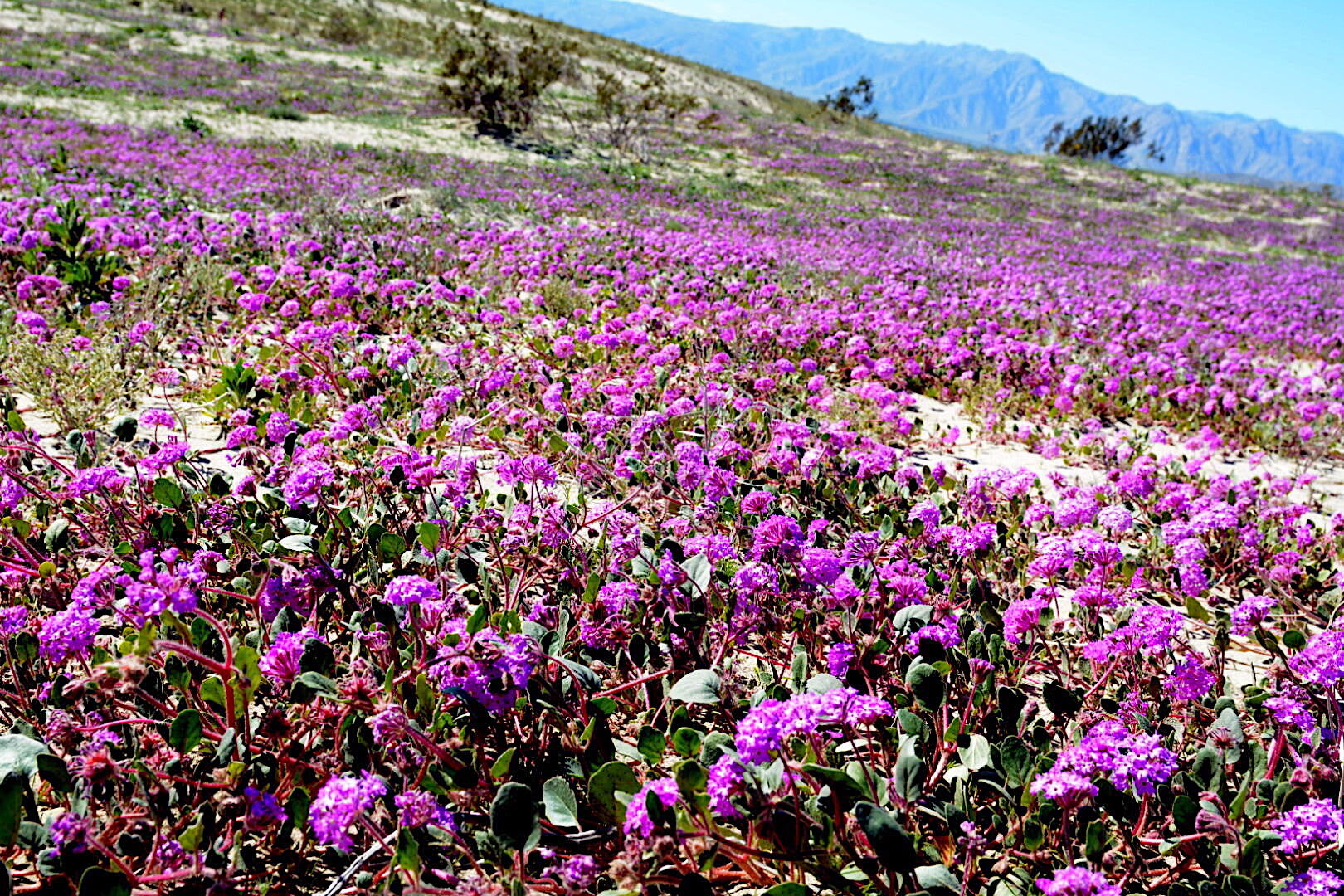
Sand Verbena (Abronia villosa)
After the talk, I drove out east of Clark Dry Lake on the road to the Salton Sea and saw large patches of Sand Verbena (Abronia villosa). There were purple, maroon carpets of the species covering acres of sandy slopes.
A few days later, the Valentine’s Day atmospheric river came to San Diego County. On Palomar Mountain, more than 10 inches of rain fell in one day and in Borrego Palm Canyon more than 3 inches fell. While the deserts had already expected to have a superbloom, that rain and other additional rain just added more precious water to the already flourishing desert plants.
In March, I had heard reports that flowers were appearing in various parts of the desert but that Henderson Canyon on the northern end of the valley where traditionally there have been extensive flowering areas, was not doing very well. People had mentioned that the eastern part of the Henderson Canyon area and large swaths of desert east of Borrego Springs were invaded by Sahara Mustard (Brassica tournefortii). I know part of the reason Henderson Canyon has had limited mustard and good native wildflowers over the years was due to people in the community removing the mustard by hand.
However, people sent me photos of Bigelow’s Monkeyflower (Diplacus bigelovii) growing in nice pink patches. While it did not seem like the flowers were going to be as good as 2017 based on reports, I thought I had to go see for myself. I left early one morning knowing that a chance of showers would occur later in that afternoon.
The sky was cloudy as I passed the Lake Henshaw turnoff. The hills were very green as I passed Hot Springs Mountain and headed for Ranchita. Driving down into Borrego Valley, the Brittlebush (Encelia farinosa) along the side of the road was beginning to flower but those on the slopes did not appear ready to flower.
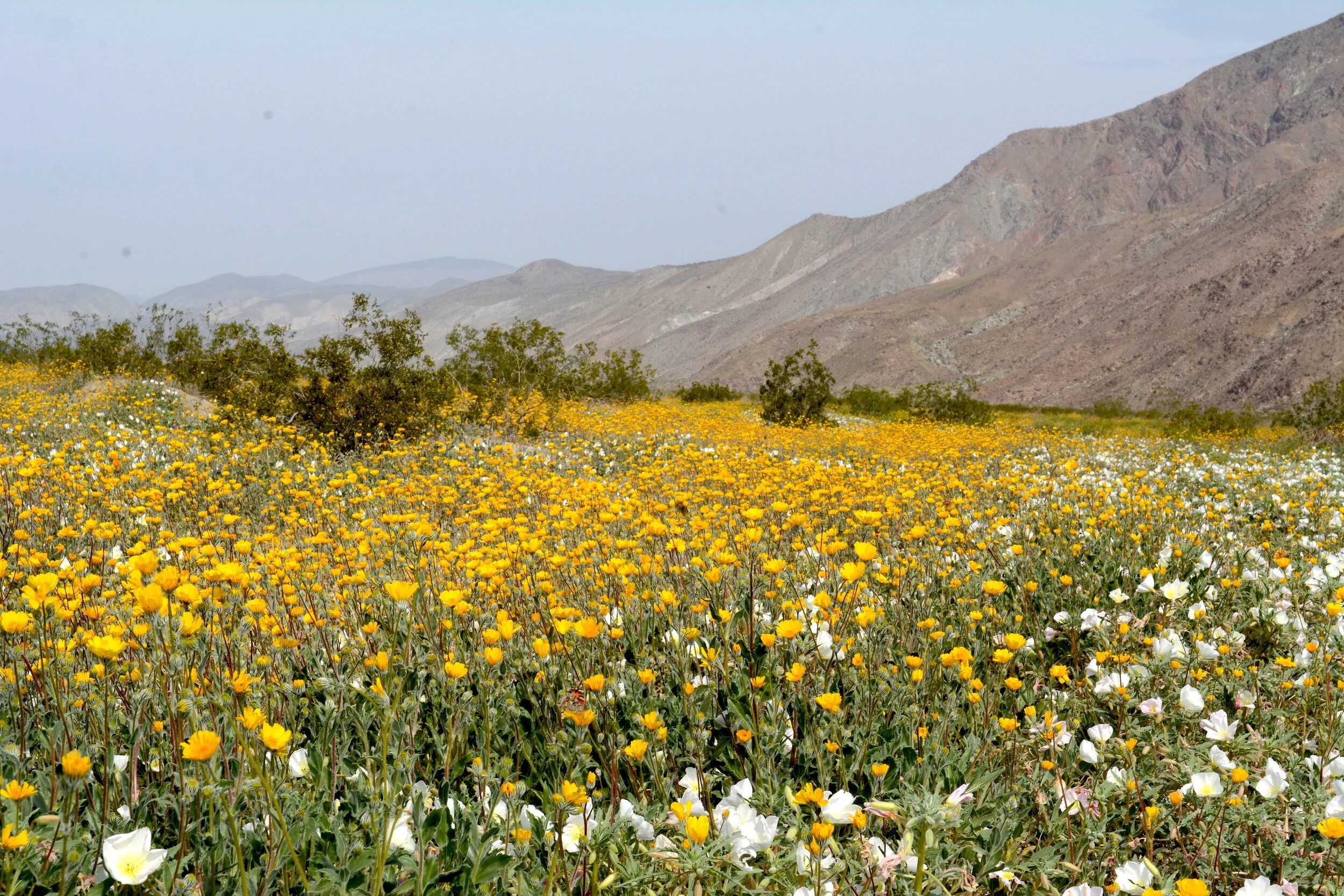
Geraea canescens and Oenothera deltoides
A breeze was blowing and the sky created a subdued tone as it was nearly entirely covered with alto cirrus ice crystal clouds, except for openings to the south where light shone through the clouds. Past the Clark Lake, the slopes still had coverage of Sand Verbena with a few Desert Sunflowers (Geraea canescens) but it was possibly a bit past the sand verbena’s prime already. I walked out on to the hill north of the road and down a draw. Painted Lady butterflies flew when I walked near. The temperature was too cool and the wind just a bit strong for them to be flying but they leapt up from the ground as I approached them. It is well known that Painted lady butterfly explosions result from early rain in central and southern Baja California, that tropical rain mentioned earlier, which provides an early start for the native host plants. As the populations of larvae swell and then pupate, adult butterflies begin a leapfrog northward migration where they reproduce along the way.
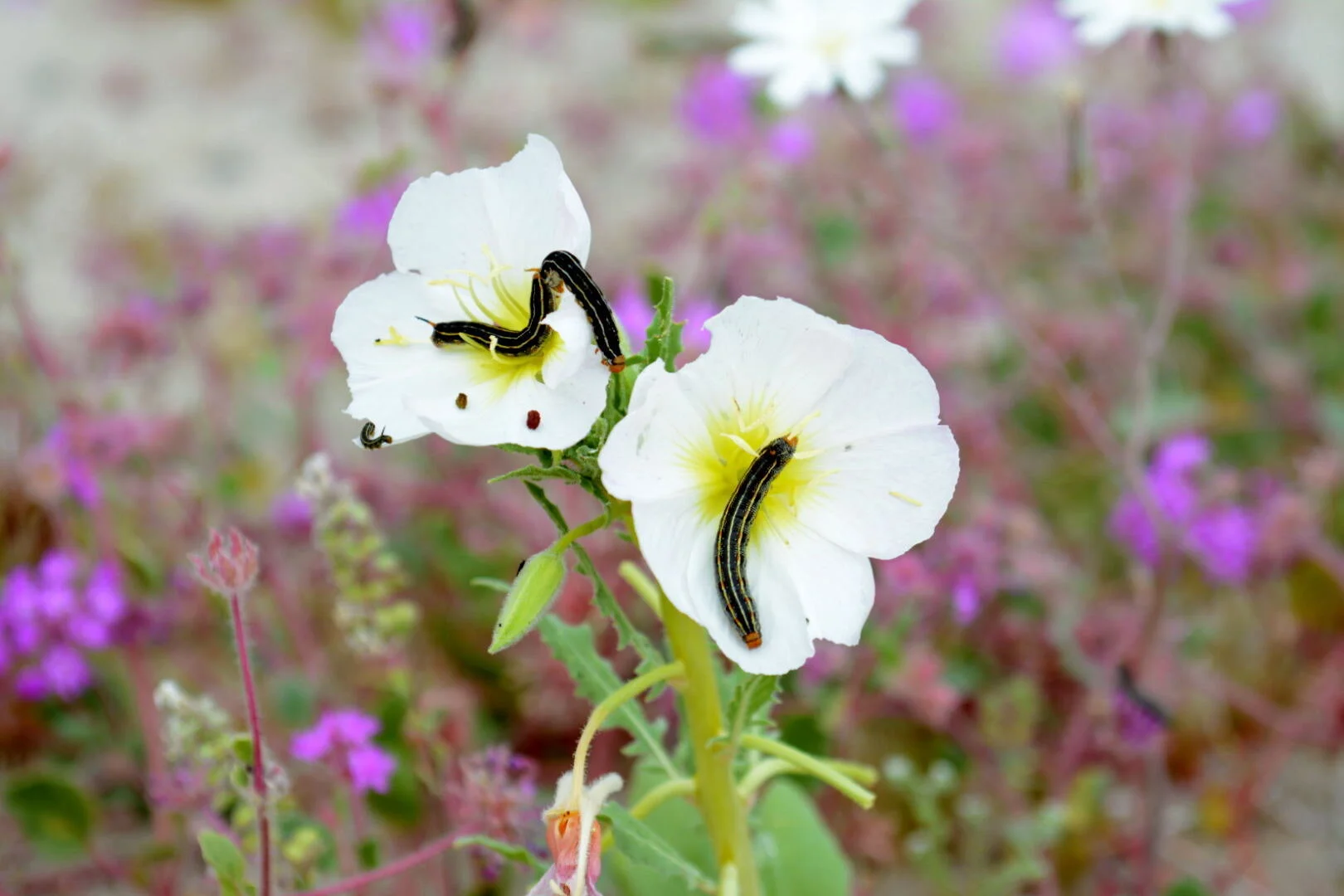
White-lined Sphinx Moth larvae were also quite common on the Evening Primroses (Oenothera deltoides). They are large black and red caterpillars with smooth skin and a red spine.
On the way back to Borrego Valley along that east end road, I stopped where open clusters of Evening primrose were spread over a large area.
The sky was still partly overcast with cirrus clouds, and the breeze was still blowing. It was overcast but not dark. I decided to check Henderson Canyon Road in spite of what I had been told about the mustard and lack of flowers. The area closest to the turn off was affected by Sahara Mustard, the tall green leafy-based annual plant with small yellow flowers. When it becomes established, it becomes prevalent and out competes the native wildflowers. However, as I drove a bit farther, the cover of Evening Primrose became greater until it dominated the vegetation on both sides of the road. Its flowers created white carpets with seemingly large tissue paper flowers spread over acres of land. On the south side of the road, they grew amid little dune hills and cracked mud depressions. On the north side of the road, they formed an extensive flow of flowers. Also, on the south side of the road many Cryptantha flowers grew; however, they were rapidly being consumed by slender, fuzzy Painted Lady butterfly larvae.
The Desert sunflower stood taller than the Evening primrose and the blowing wind ruffled the Oenothera petals. The Desert sunflower appeared to be marching forward with the taller slender plants moving toward me as the wind flowed out of Coyote Canyon.
The high clouds were fading and the sun shone more brightly. The number of Sphinx Moth and Painted Lady larvae was high. Adult painted lady butterflies flew over a large Creosote Bush (Larria tridentata) shrub that was in full flower. They appeared to be floating around the shrub.
I walked back to the car and crossed to the north side of the road where the flowers were deeper and denser. I walked farther as the flowers shifted to more sunflowers and then to a mix of the Evening Primrose and the sunflowers. I was past the area of influence of people walking out into the flower field. Nearby, a family had launched a drone but it did not fly far from the edge of the road. The conditions were very beautiful, and it was an uplifting environment. Eventually I felt that I had seen and photographed enough of the blooming flowers.
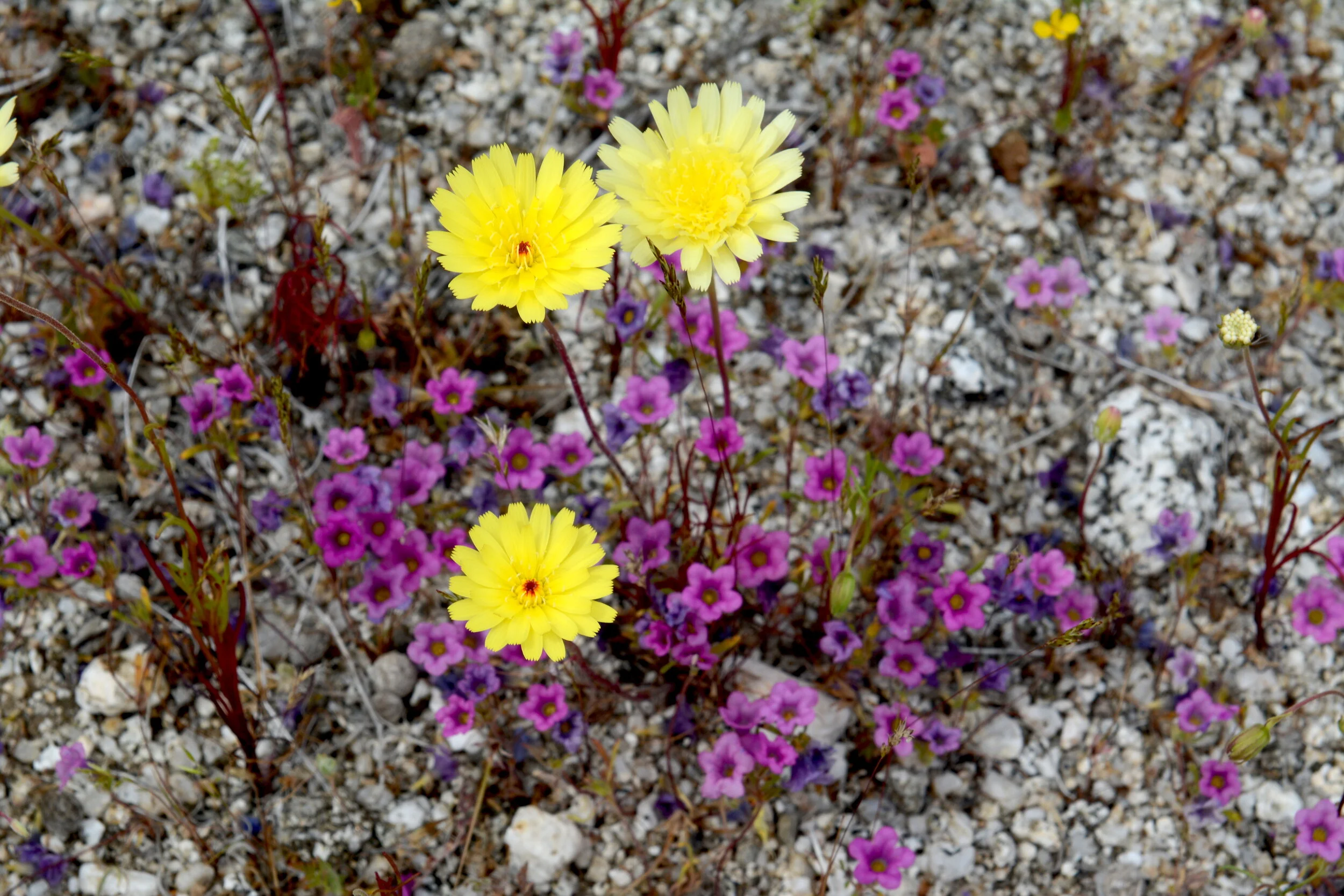
Malacothrix glabrata and Nama demissa
I drove out on the road to Coyote Canyon. Along Di Giorgio Road grew large patches of bright lemon-yellow Desert Dandelion (Malacothrix glabrata) with Purple Mat (Nama demissa). At the end of the pavement, it was clear that the overall number of annual plants was very high. It almost seemed that the number and density of annual flowers was greater than it was in 2017.
I stopped several times to photograph the flowers and the light-dappled hills to the southwest. Patches of yellow Desert Poppy (Eschscholzia parishii) were visible on the slopes of the mountains. Desert Pincushion (Chaenactis stevioides), with white pincushion-like flowers, and purple Arizona Lupine (Lupinus arizonica), were also very common and widespread. The white flowers of California Chicory (Rafinesquia californica) were also prevalent, especially in the shrub areas. All were blowing in the wind.
I was walking back to my 20-year old vehicle when I ran into several people I used to work with at AECOM. I drove out as the light rose higher and had planned to see what flowers were blooming in Palm Canyon. As I approached the entrance to the State park, I was stopped by an emergency vehicle and they closed the entrance for several hours. I turned around and headed toward Hell Hole Canyon. Two years ago, Hell Hole Canyon was quite good with wildflowers. I thought I would look for monkeyflowers and others that had been described to me as being present in Palm Canyon.
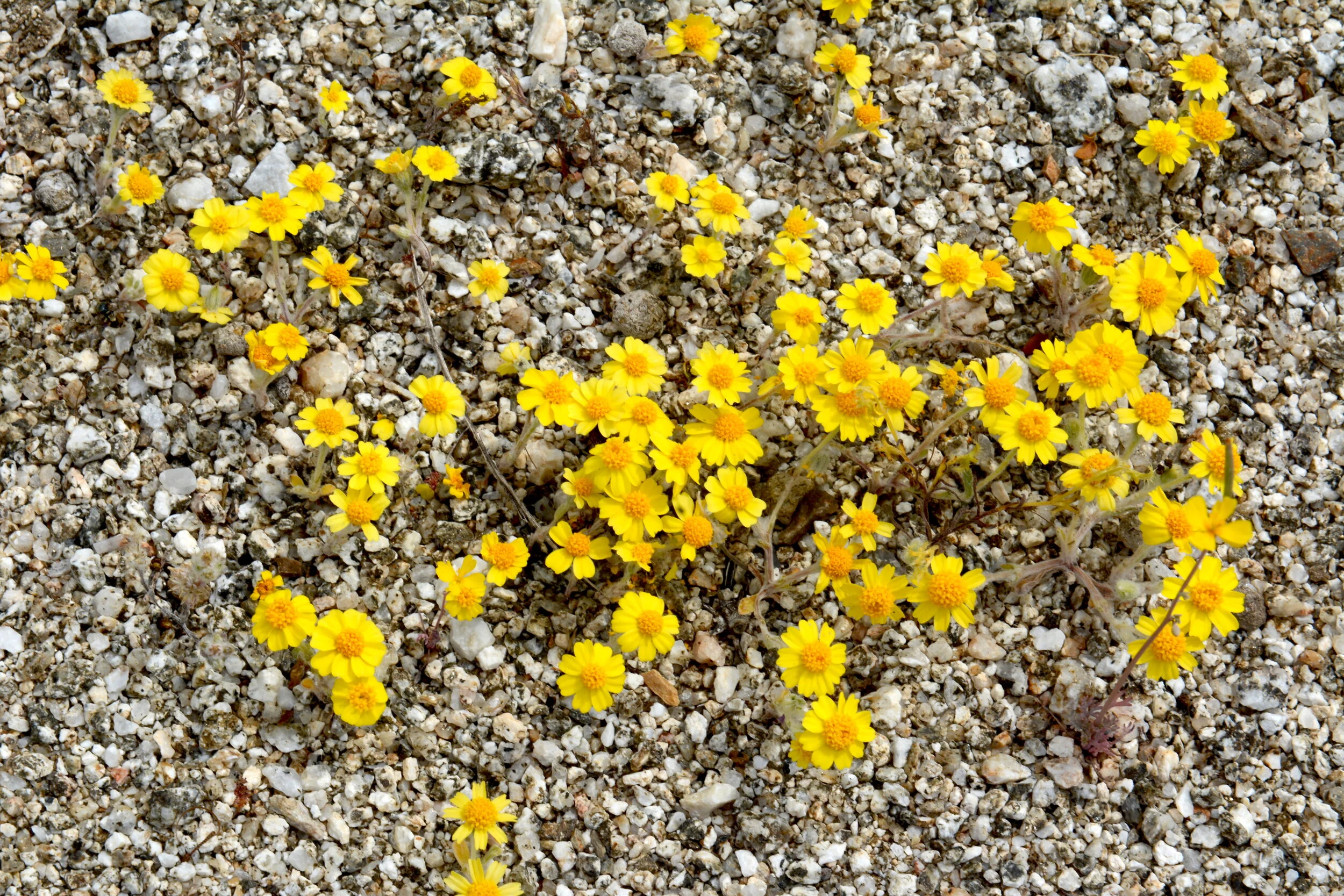
Wooly Daisy (Eriophylum wallacei)
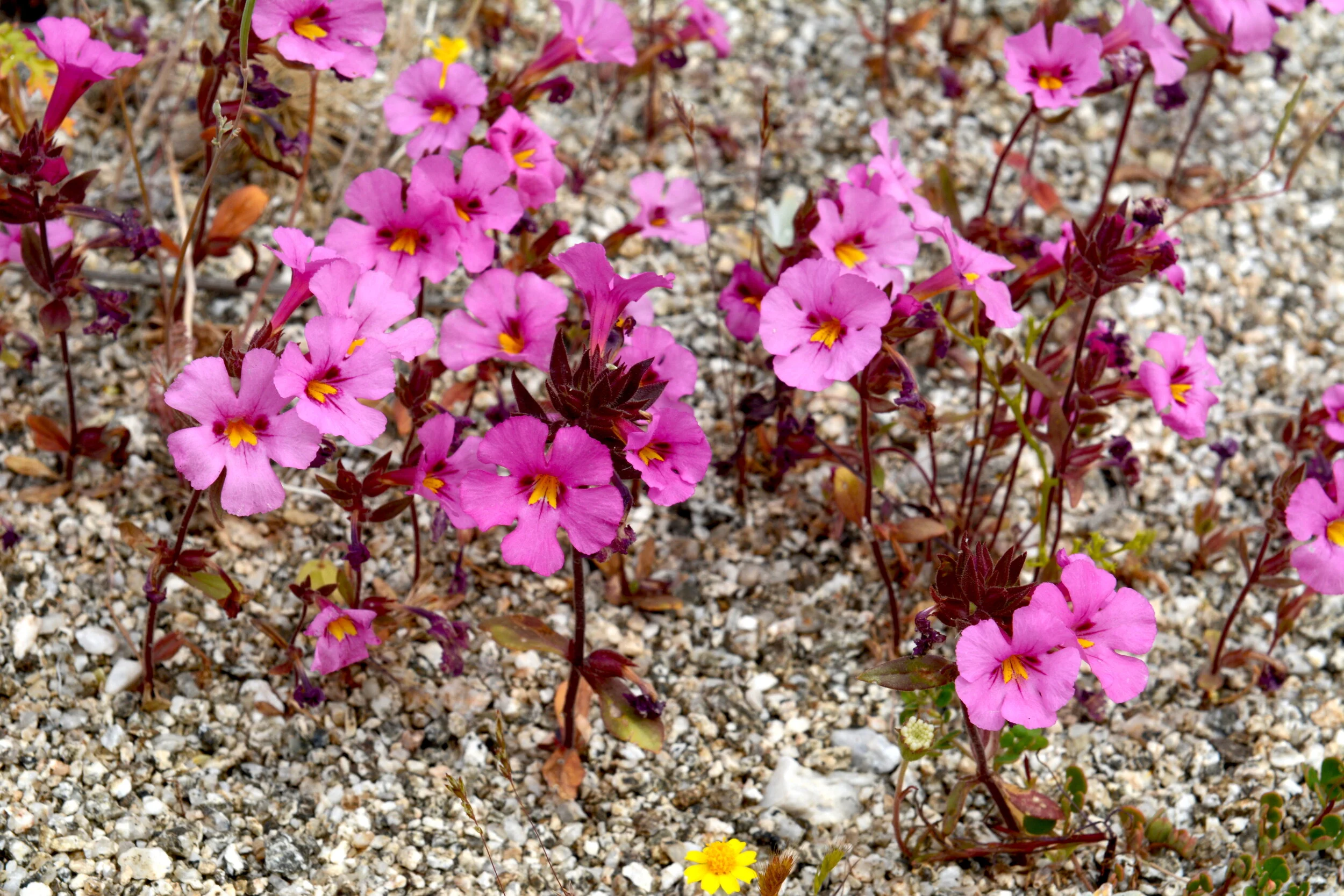
Bigelow’s Monkeyflower (Diplacus bigelovii )
I began walking up the wide valley after parking at the trailhead. It immediately became clear that the annuals were doing very well there and were very dense. I encountered patches of bright yellow Woolly Daisy (Eriophyllum wallacei) in slightly lower areas. I came across some purple and pink patches of Purple Mat (Nama demissa) and also Desert Star (Monoptilon bellioides) with its white flowers in inflorescences the size of a quarter and with the flowers sitting directly on the ground. A little farther up the valley I came across patches of the bright pink-red Bigelow’s Monkeyflower (Diplacus bigelovii; left) with stems about 6 to 10 inches tall and growing in dense patches. The wind continued to ruffle the flowers. Some patches were mixes of flowers with the bright pink monkeyflowers, the deep yellow and low growing Woolly Daisy, and the taller yellow Desert Poppy. The Brittlebush shrubs (Encelia farinosa; below), were not flowering as much as two years ago; however, the ground cover Desert Dandelion was extensive.
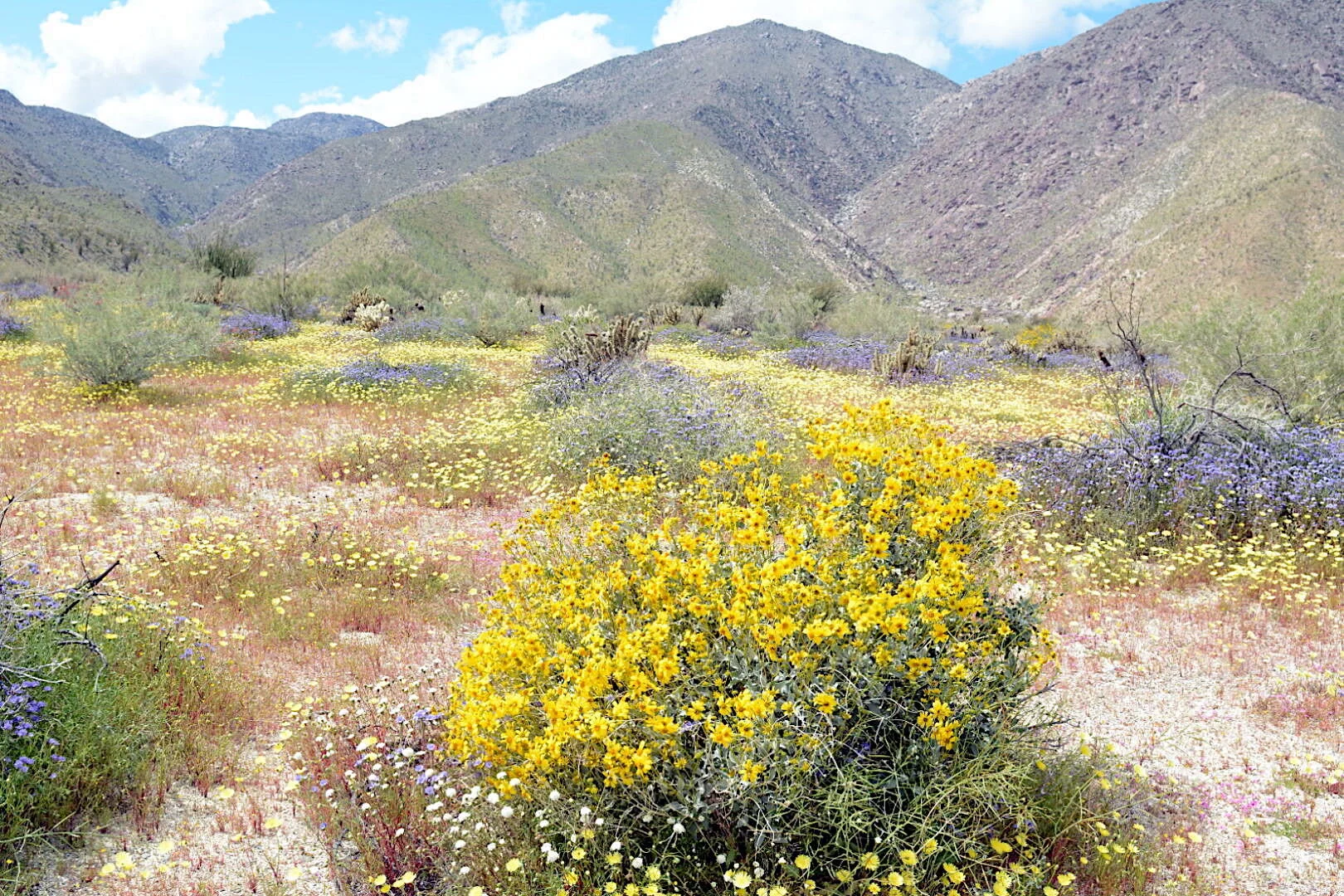
Encelia farinosa in Hellhole Canyon
Back in the car and driving up the grade, the light was beautiful and I was fascinated by the nearby hills. As I passed Ranchita, the sky to the west was cloudy and clearly dropping rain near Lake Henshaw. It appeared the storm was on its way to Santa Ysabel.
The area was covered in green, but I did not see any sign of poppies that I had seen flowering there in past seasons. I stopped at the Julian Pie Company for a piece of cherry pie since Dudley’s bakery was closed that day. I pulled into the parking lot in Santa Ysabel after passing by the green hills with still barren Black Oaks (Quercus kelloggii) near Santa Ysabel Indian Reservation and Morrettis Ranch.
I sat in my car for a little while and could see the cloud patterns shifting around. A low cloud base came blowing from the northwest bringing a band of fog down to the surface as the clouds moved overhead. Later, as I drove west on the highway, the clouds again came down near the ground and dropped a significant rain for a short duration. The clouds showered off and on for a while as I entered Ramona. The streets were wet and as I passed Mount Woodson, I saw an ominous wall of clouds to the south that later dropped heavy rain in the Lakeside area.
A week later, I decided to try again to make up for my photos that were over exposed. I headed out early again, leaving at 7 am. No rain was predicted, but the sky was still cloudy. The greenery during the drive through fog and traffic and up SR- 67 past Mount Woodson and Iron Mountain, through Ramona and out the windy road past Witch Creek and Santa Theresa Valley, was stunning in the morning light. Then I dropped down into the valley with Santa Ysabel. I was watching the hills in the darker crest north of Ranchita, looking for the pines on the ridges. I could tell as I drove down through Culp Valley that flowering had advanced. I could see that the Brittlebush was flowering more than the week before, but they were not as flowerful as they were in 2017.
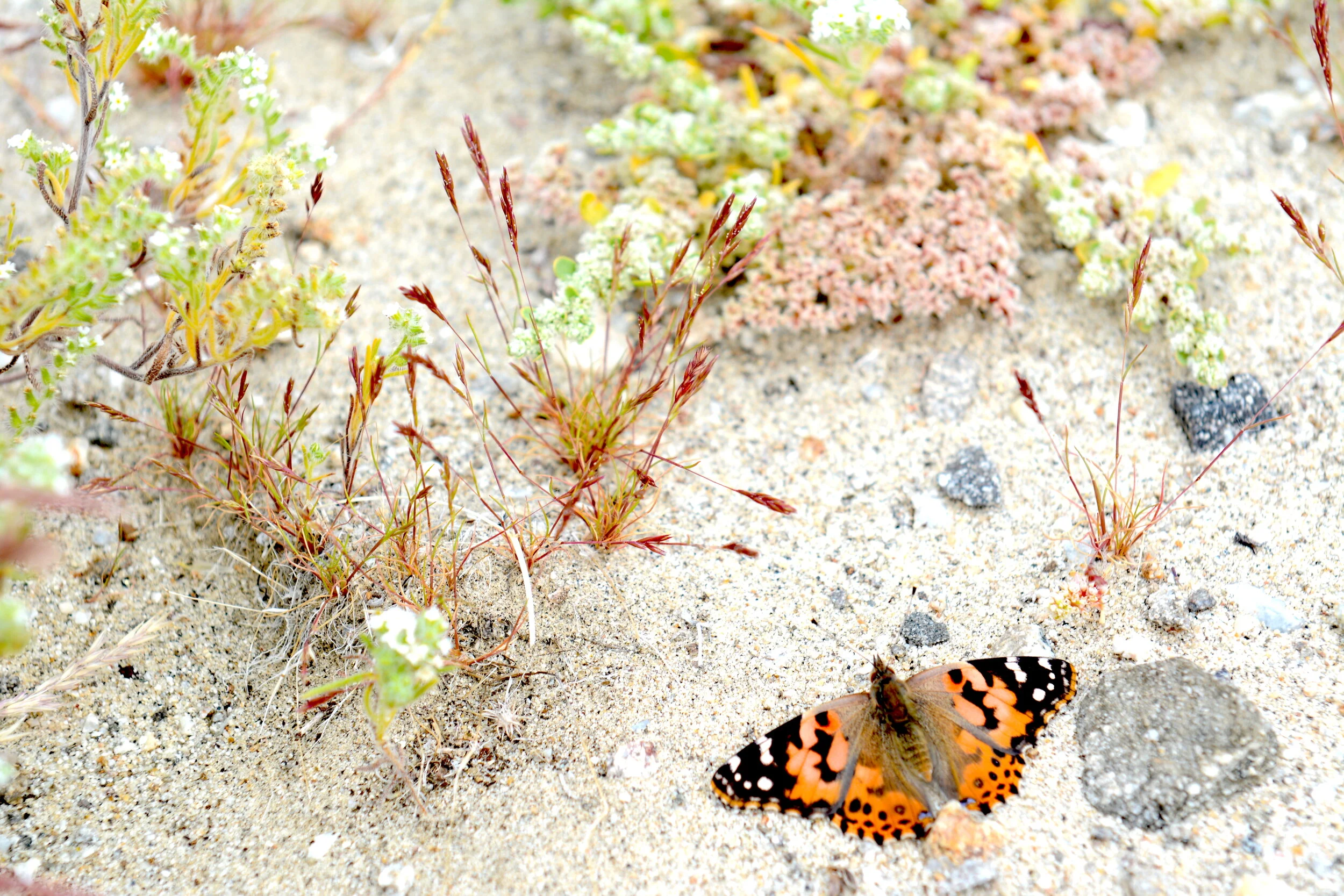
Painted Lady butterfly with Common Mediterranean Grass (Schismus barbatus) and Popcorn Flower (Cryptantha sp.).
I drove on down into Borrego Valley and back to Henderson Canyon. The sun was shining more that day but there was no breeze. I went to the southern side of the road first. The Popcorn flowers were nearly gone by being devoured by the Painted Lady larvae. The ground was covered with caterpillar poop, but the fuzzy larvae were much less prevalent. The ones that I did see were on the move, traveling quickly across the ground. However, there were still plenty of adults flying around the Creosote Bushes.
The flowers on the north side were also more advanced than they had been the week earlier. However, a greater number of Desert Sunflower were in flower. The wind was not blowing so the plants were not moving as they were the previous week, but the sky was brighter. It was still beautiful. I eventually drove back out onto Di Giorgio Road and into the mouth of Coyote Canyon. I stopped to photograph the Desert Dandelion and the hills to the southwest in the San Ysidro Mountains. The flowers were very tall and dense. The Ocotillo (Fouquieria splendens) was still not blooming but some of the cacti were beginning.
I drove back out and headed toward Hellhole Canyon again. The small annual flowers (Diplacus spp. and Eriophyllum spp.), were not quite as sharp but the Encelia was in better flower and more yellow than before. The Desert Dandelion seemed more dense in contrast to the other annuals and the Desert Pincushion was also very common, making white dots in the spaces around the Desert Dandelions that filled all of the space between the shrubs with a bright yellow carpet. I came across some people who had been in Palm Canyon earlier that morning and they had seen Bighorn Sheep down next to the trail. It must have been interesting to see the flowering Brittlebushes and the Bighorn Sheep together.
At Santa Ysabel, the landscape with the oaks in the distance was all dark green. Spring in the deserts and mountains is awesome during years that have good rainfall. During November and December 2019, we had a good start to the current rainfall season. That rain will cause some wildflowers, but how good the season becomes will depend on rain at the end of January, and during February and early March.
All photos by Tom Oberbauer