

CONSERVATION – Silphium, White Sage, and Burning
By Frank Landis, Conservation Committee Chair & Rare Plants Chair
Over the years, I’ve occasionally written about silphium. Here I’m not talking about the genus Silphium, which are gorgeous and rare tall prairie plants that I remember fondly from Wisconsin. Instead, I’m talking about an extinct fennel relative that grew in ancient Cyrenaica until it disappeared during the reign of Nero. For 1,500 years or more before that, it had been popular in food, as perfume, and also as an herbal contraceptive. It purportedly was worth its weight in silver, and its export made Cyrenaica wealthy. It was never domesticated, and researchers still argue about what combination of overharvesting, overgrazing, and local climate change wiped it out.
Why do we care? Well, like all members of the Apiaceae (the carrot family), silphium had these little two seeded fruits. Because of their value, they showed up in art from the Minoans on. You actually know it quite well, because it’s where we get our symbol for a heart: ♥. Our symbol of love is an extinct herb.
The other reason to care is that silphium’s home range was on the seaward side of what is now Libya’s Jebel al-Akhdar plateau, a strip of land about 30 miles wide and 125 miles long, basically like the coast of San Diego County. Silphium was the first in a long line of plants that were overharvested in their limited native ranges and either became rare or went extinct.
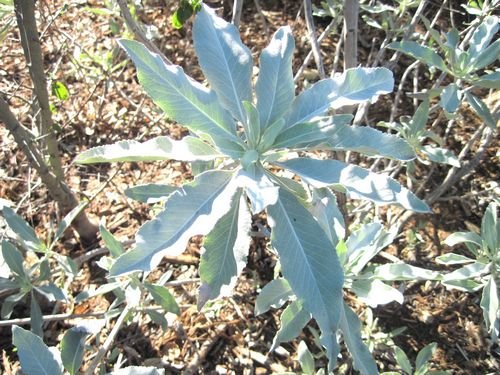
White sage (Salvia apiana). Photo credit: Calscape.
For several years now, thanks to the efforts of Rose Ramirez and Deborah Small, we’ve become aware that white sage (Salvia apiana: Photo below: Calscape), a California native that mostly grows on the coastal sides of mountain ranges locally, is being overharvested and poached for a burgeoning trade in sage smudges, egged on by Hollywood’s embrace of a New Agey smudge in the abalone shell version of more traditional Native American smudging rituals. As with the Dudleyas, CNPS is encouraging everyone to fight back by growing their own white sage and encouraging others to plant more of it, to destroy the market for the poachers. The new video Saging the World is about this problem, and you should see it.
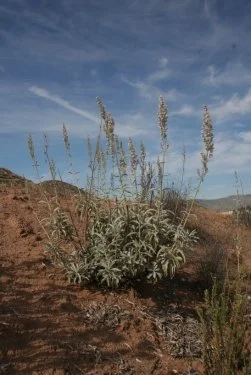
White sage (Salvia apiana). Photo credit: Calscape.
The deeper issue is human’s relationship with fire. If you believe anthropologist Richard Wrangham’s argument (Catching Fire: How Cooking Made Us Human), humans literally coevolved with fire. The ability to cook food meant that we could have weaker jaws and smaller guts than other apes, freeing up all the resources and energy from our GI systems to produce more children and bigger brains. All fire does is to oxidize organic material, releasing the sunlight stored in it as heat, so even if we don’t cook over wood fires much anymore, using heat to make solar panels, wires, and electric cook tops is just an elaboration of our multi-million-year relationship with fire.
From here I’m going to segue from our human need to burn things into talking about the Intergovernmental Panel on Climate Change (IPCC) 6. As pretty much anyone who’s paid attention knows, the current IPCC round of reports says that, as a species, we’re not seriously trying to make any headway in reducing out greenhouse gas emissions. If you believe humans coevolved with fire, the news that we can’t stop burning things as easily as some might want us to should come as no surprise at all.
The latest IPCC 6 report, out a couple of months ago, includes a number of models for the future, but they fall into three classes. One class is business as usual, where we release enough GHG’s to cause 3-4oC of climate weirding. This will take many decades to happen, and it will cause damage to global economies equivalent to perhaps half the current US GDP, or 1/8 global GDP, per year. Most likely much of this will never get fixed, and that’s how civilization as we know it goes down.
In another set of models, civilization devotes about 30% of its GDP annually to sequestering carbon for the foreseeable future, and goes on about business as usual as best it can with the other 70% of its economy.
In the third set of models, civilization devotes 10 to 15% of its GDP annually to sequestering carbon for the foreseeable future, and also substantially decreases annual energy use each year. The difference here is that by using less energy, we produce fewer GHGs, so we can get by with sequestering less.
This isn’t the order that the IPCC presented these three models in, because they put business as usual at the end. Everybody’s reaction was that the other two models are impossible, so we’re doomed. I wanted to highlight the fact that if we do nothing, we lose as much as if we do something. We might choose to be doomed, but it’s in no way inevitable. We can choose to live instead.
So, what ties silphium, white sage, and climate change together? No, it’s not that humans are innately evil. If nothing else, fossils demonstrate that anatomically modern humans have been around for 300,000 years or more, burning the entire time. It’s only in the last 2,000 years that “we” (mostly Rome and cultures that look back to it) have gotten into making things extinct for pleasure. With the Romans, it wasn’t just silphium, it was European lions and North African elephants, slaughtered in the Roman arenas for sport. Be that as it may, there’s a cultural component here, one that comes from ancient Rome. It’s the idea that we’re consumers, flames that exist only to grow, consume everything we can, and gutter out when we can’t find new fuel.
Our consumer culture becomes more burdensome when the IPCC talks about the need and probable inevitability of our economy, signified by our gross national product, shrinking, either mindfully to deal with climate change, or chaotically if we don’t deal with climate change. How will we keep consuming?
Does It have to be this way? Oh, hell no. As I noted above, humans do many things with fire. We don’t have to be the culture of the all-consuming flame. Let’s go back to white sage again.
One problem with the Saging the World campaign is that it gets people focused only on burning sage. White sage is quite useful as a living plant. It’s right there in the name Salvia apiana. That specific epithet (botany lesson: that’s the second word in the name) refers to bees, because bees love white sage. You can buy sage honey. If you keep honeybees, keep a field of white sage for them to be happy in, give away their honey to your “real friends” and find out how many friends you have. Or keep it for the native pollinators. You can burn some too, but if one dry leaf is enough to smudge your house (trust me, it is), how much do you really need to burn?
Moving out a step, we tend to feel that our “Roman inheritance” is the essential part of our civilization. In doing so, we forget that we inherit quite a lot from the Native Americans, too. As Gary Nabhan has written in several books, he’s had quite a lot of luck finding rare plants growing where native people planted them, not out in “the wild” where humans don’t go. Nurturing natives is part of our heritage, too, if we choose to recognize it. We can, and do, care for and grow native plants. We could even further embrace our Mediterranean and native American heritages and figure out better ways to work with fire on the landscape, as everyone’s ancestors did once.
Moving outward to the IPCC, yes, Gross Domestic Product will shrink, mindfully or otherwise. So what? We have to realize that growing our GDP statistic has become a game that’s no longer worth playing. It’s never been an immutable reality, nor has it ever kept everyone fed, watered, clothed, housed, or happy. In the process of growing our economy, we’ve done things like waste 95% of the old growth redwood forest. And they were wasted—most of the wood from those ancient trees is trash and GHGs. Was it worth it, wasting so much for so little?
Maybe, as part of our process for dealing with climate change, we need to embrace different games, like measuring Gross National Happiness instead of GDP. While I’m out of space to explain what GNH is (Wikipedia is your friend), if we figure out how to meet people’s needs, end extinctions, and live happily while doing so, why does it matter if our GDP statistic decreases? After all, we may need fire to be human, but we can do very much more with it than burn everything.
Fantastic article. Thanks.